Meat Rails and Market Mornings: A Butcher's-Eye Walk Through Smithfield
Smithfield is best understood on foot, and preferably before the City has finished its first coffee. The meat trade here is not a museum exhibit bolted onto a shopping district; it is the reason the streets bend the way they do, why the pubs open early and why the market buildings still feel like working premises rather than heritage set-dressing. This walk uses the market's own architecture and a handful of nearby landmarks to trace that story. Allow two hours without stops, three if you intend to do it properly.
Before you set off
Start at Grand Avenue, the covered spine of Smithfield Market, on a weekday morning if you can. The market is a working site, so do not wander into loading bays or treat the stalls as a photo set. The route is flat and roughly two miles, with cobbles and kerbs that punish flimsy shoes. Check opening times before you travel, especially if you want to look inside the market buildings rather than around them. In 2026 the area is still in flux, but the early-morning rhythm remains the best introduction to the place.
Grand Avenue: the spine of the trade
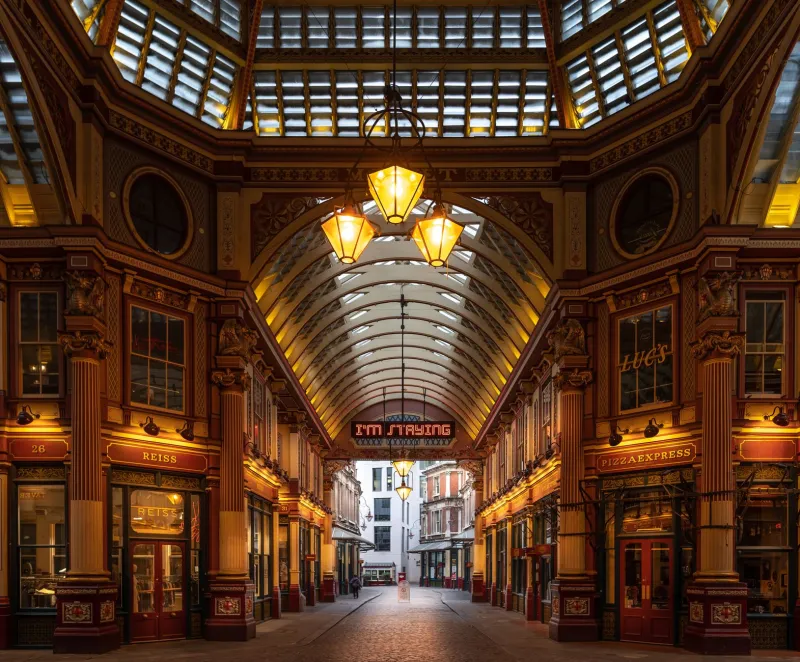
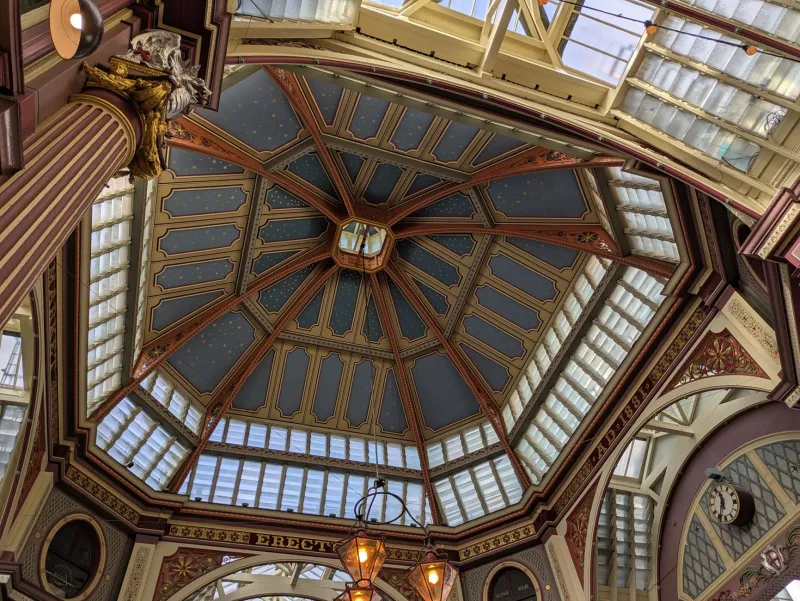
Stand under the iron roof and look along the central aisle. Grand Avenue was laid out as the market's main artery, a covered street where porters, buyers, inspectors and salesmen crossed paths. The present buildings date from the late 1860s, designed by Sir Horace Jones, the City architect who also had a hand in Billingsgate and Leadenhall. Look up at the columns and roof trusses; look down at the worn stone. Then look for the overhead rails. Those meat rails are the giveaway. Carcasses were moved along them from van to stall, a quiet piece of engineering that made the market work.
The East and West Buildings: iron, tile and cold store
Walk the length of the market and notice how the buildings are divided into stalls and shops, each with its own frontage and its own small theatre of display. Smithfield's livestock market was ancient, but by the mid-nineteenth century the live animals had become a public-health problem. The live trade moved out in 1855, and the covered market that followed was built for dead meat, refrigeration and inspection. The tiled walls and hard surfaces were not decorative; they were there to be washed down. Look for the old cold-store doors and the places where rails disappear into walls. This is the meat trade as infrastructure, not just as butcher's block.
West Smithfield and the St Bart's gate
Cross to the hospital side of West Smithfield and pause by the gatehouse of St Bartholomew's Hospital. The hospital was founded in 1123 by Rahere, a courtier who turned monk after a pilgrimage. It has been on this site for centuries, and it has always had a practical relationship with the market: people who worked with meat needed doctors, and the hospital needed to eat. The gate is a good place to think about the less romantic side of the trade — accidents, infections, long shifts and the ordinary business of feeding a city.
Cloth Fair and St Bartholomew the Great
Slip through Cloth Fair to St Bartholomew the Great, the Norman church that survived the Reformation and the Great Fire. The nave is heavy, dark and astonishingly old. The surrounding streets once hosted Bartholomew Fair, a rowdy annual gathering that drew Londoners of every sort. The fair was not a meat market, but it belonged to the same Smithfield world of crowds, livestock, noise and appetite. Look for the half-timbered houses on Cloth Fair and the churchyard quiet. It is a sharp contrast to the market's clatter, and that contrast is the point: Smithfield has always held sacred and profane together.
Giltspur Street and the Golden Boy
Walk down to Giltspur Street and find the Golden Boy of Pye Corner, a small gilded figure marking where the Great Fire of 1666 was said to have stopped. It is not a meat-trade monument, but it belongs in the walk because fire was the constant fear of every timber-built market. The City rebuilt in brick and stone, and the meat trade rebuilt with it. From here, turn north towards St John Street.
St John Street: the old droving road
St John Street was part of the route by which cattle and sheep were driven into Smithfield from the north. Think of that as you walk: animals on the hoof, drovers with sticks, pubs and smiths along the way. The street now feels like Clerkenwell rather than cattle country, but the width of the road and the old frontages give a hint of the traffic that once came through. St John's Gate, with its Tudor stonework, is a reminder that this area was once a religious precinct as well as a trading one. The meat trade grew up around institutions, and the institutions grew up around the trade.
Coffee, lunch and a pint
For coffee, head to Leather Lane and try Department of Coffee and Social Affairs. It is a modern stop on an old route, which is exactly the sort of mix Smithfield does well. For lunch, walk to the Quality Chop House on Farringdon Road. The building began as a working men's eating house in 1869, and the menu still understands meat, fat and salt. Order the chop, the confit potatoes and something green to pretend you are being sensible. If you want a pint instead, The Hope on Cowcross Street is a proper pub with a market-adjacent mood. Check hours before you go; pubs and caffs around here keep market time, not tourist time.
The walk in short
Start at Grand Avenue, follow the market rails, cross to St Bart's, slip into Cloth Fair, find the Golden Boy, then walk up St John Street. It is not a grand set-piece route. It is a butcher's-eye view of a quarter that has been feeding London for centuries, and it rewards the sort of slow looking that a coffee stop or a pint makes possible.