The Nod and the Number: Inside Smithfield's Vanishing Art of Bidding
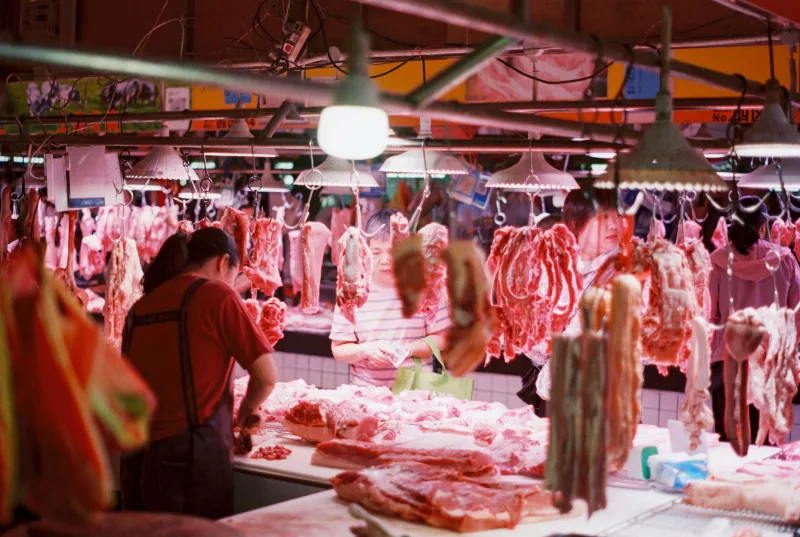
At 3.47 on a Tuesday in November, the Grand Avenue is already a corridor of cold and low talk. Above, the Victorian ironwork is doing what it has done since the 1860s — holding up a roof and letting the draught through. Down at eye level, a row of beef sides hangs like the pages of an extremely heavy book, and at the end of the row a man in a navy fleece is warming up his voice the way a singer might.
Ray has been calling stock at Smithfield for thirty-one years. He does not shout. The chant, when it begins, is closer to a shipping forecast than a showman's patter: quick, flat, faintly bored, carrying numbers the way a postcode carries a street.
'Right then. Fifty-two. Fifty-two. Fifty-two and a half. Fifty-five. Thank you, sir. Fifty-five. Fifty-six…'
The room before the call
The bidding does not begin with the gavel. It begins an hour earlier, in the grading.
Hanging beef is assessed the way the trade has assessed it for generations: conformation and fat cover, weight band, days hung, the farm on the ticket. A grader walks the row with a clipboard and a practised squint, and by the time Ray clears his throat the lots have already been sorted into the only hierarchy that matters at four in the morning — what it is, and what it will stand.
Around the rail, the buyers arrive in ones and twos. There is a wholesaler in a gilet who supplies half of Clerkenwell. There is a butcher from a shop with a tiled frontage and a queue on Saturdays. There is a woman who buys for three restaurants and a hotel banqueting kitchen, and who has the particular stillness of someone who has already done her sums. And there is a young man on his second week, holding his catalogue too tightly.
A language made of nods
What follows looks, to the untrained eye, like very little happening.
The code is small on purpose. A lifted chin. A pen tapped twice on a folded page. A thumb moved perhaps a centimetre off a forearm. The old hands barely move at all; a newcomer who waves gets a sharp look and, occasionally, a lot he did not mean to buy.
'If you wave, you've bought it,' says Nadia, who has been buying here for nine years. 'You learn to keep your hands by your sides and your face very boring.'
That economy of gesture is not just manners. It is credit, reputation and memory compressed into a twitch. A nod here is a contract, settled on account, invoiced later, remembered for years. Nobody asks for a deposit. Nobody asks for ID. The room runs on the fact that everyone expects to see everyone again on Thursday.
What the hammer is really saying
Here is the part that surprises people outside the trade: the gavel rarely discovers a price. Mostly, it confirms one.
By the time a lot comes under the call, the floor has already worked out roughly where it should land — a base set by grade and weight, adjusted by breed, by season, by what came in on the lorries overnight. The auctioneer's job is to find the last half-penny in the room, and to do it fast enough that ninety lots clear before the sky turns grey over Farringdon Road.
The call is also a form of insurance. When Ray says 'fifty-five, thank you, sir', the number is public. It goes on the sheet, into the system, out to the trade. Everyone in the room now knows what a beast of that stamp is worth this morning, and can price their own accordingly. That shared, audible number is the quiet service the market performs for the rest of London, most of which will never see a hanging side in its life.
When the screen takes over
Which is precisely what is changing.
Electronic bidding is not new, but it is spreading — timed sales, phone bids, a screen at the end of the row showing a figure that ticks upward with nobody in the room having moved a muscle. On paper it is better: wider reach, a written record, no one misreading a thumb.
In practice, something goes missing, and the buyers will tell you what.
'The room tells you things the screen doesn't,' Nadia says. 'If a certain buyer goes quiet, you know he's already full. If he's bidding hard, something's short somewhere. You read the room, not just the price.'
A screen shows you the number. It does not show you the man who is bidding because a delivery failed at 2am, or the woman who is holding back because she knows a bigger consignment lands on Friday. Those small human tells are the market's real intelligence, and they only exist when people are standing near each other in the cold.
The price London wakes up to
By six, it is over. The fleeces are zipped, the catalogues folded, the sheets signed. Ray's voice is down to a rasp. Somewhere a forklift reverses, and the Avenue begins to empty into vans heading for Shoreditch, Soho and a dozen kitchens that will have their mise en place done before the first customer asks for the list.
On the board, the numbers stand. A side of beef that was, at 3.47, merely a shape in the dark is now a price, a commitment, a line in a ledger — and, later tonight, someone's supper.
The gavel will not last forever. The screens are patient and the economics are persuasive. But for now, in the small hours, London's most consequential financial market is still being run by a man saying numbers quietly and a room full of people trying not to move.